
Arapahoe ACTC Release Path
Arapahoe Community Treatment Center is operated by CoreCivic and is identified in the research as a community-corrections center with a Colorado Department of Public Safety customer base. The facility address is 3265 Girard Ave., Englewood, CO 80110, and the phone number captured in the research is 303-761-7685. The key release issue is that ACTC is not a sheriff jail roster source. A resident may be there as a direct sentence, a re-entry placement after prison, a condition tied to parole, or a court-connected community-corrections placement.
That changes the record path. A person leaving ACTC may have an exit, completion, transfer, revocation, or supervision change rather than a simple jail release. The Arapahoe County current inmate lookup should not be treated as an ACTC resident list. If the person is found in that jail lookup, it means a separate Arapahoe County jail booking may exist. If the person is not found, the next step is the court order, CDOC if the placement followed prison, or the supervising office.
The CoreCivic Arapahoe Community Treatment Center page is the matching facility source captured for this page.
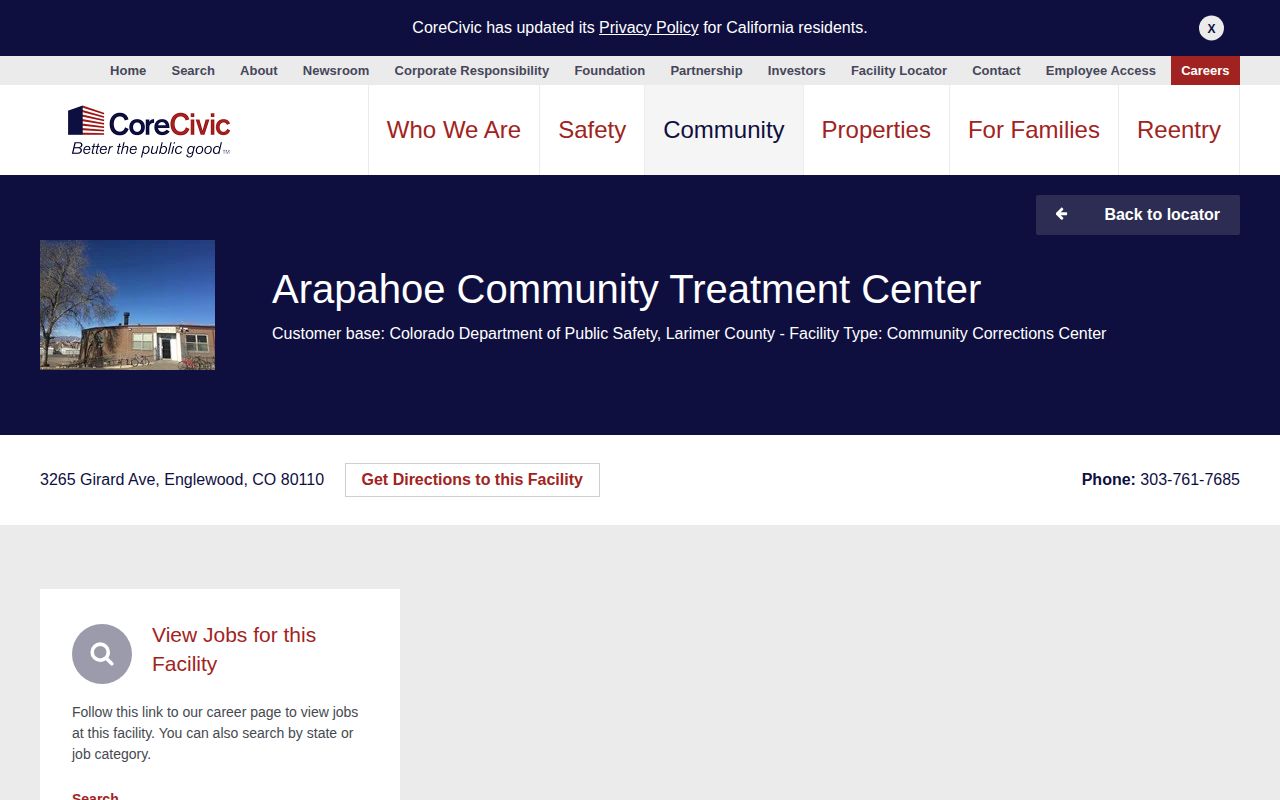
The image source confirms the facility context, while official release verification still depends on court, CDOC, or supervision records.
Confirm an ACTC Exit
Start with the placement authority. For a direct sentence, the Arapahoe court file should show the sentence, placement conditions, later modification, completion, or revocation. For a prison re-entry placement, CDOC records may show the prison release, parole status, discharge date, or related sentence status. For a probation placement, the probation office and court file are the stronger route. The county Community Corrections Board gives local facility context but does not replace the case record.
- Identify whether the placement followed a court sentence, prison release, parole condition, probation condition, or later modification.
- Search the Colorado Judicial Branch docket for the Arapahoe case, then request documents if the docket is not enough.
- Use the Arapahoe County Community Corrections Board page to confirm ACTC's local community-corrections role.
- Search CDOC by DOC number or name when the person came from Colorado prison.
- Call ACTC at 303-761-7685 for facility routing if the inquiry concerns a current or recent placement.
- Use parole or probation contacts for ongoing supervision after the person leaves the center.
Note: A missing name in the county jail lookup does not prove a completed ACTC release.
ACTC Records and Contacts
The research points to several record custodians rather than one all-purpose ACTC release list. CoreCivic can route facility questions. The Arapahoe court file can show the placement order or later court action. CDOC can show prison release and parole status if the placement followed prison. Probation can confirm court supervision where public contact is appropriate. The Sheriff's Records Unit is still relevant only when there is a separate jail booking, custody report, or transfer through the Arapahoe County Detention Facility.
Arapahoe Community Treatment Center
3265 Girard Ave.
Englewood, CO 80110
Phone: 303-761-7685
Type: community-corrections center
| Record question | Best channel |
|---|---|
| Direct sentence or court order | Colorado Judicial Branch Arapahoe court records. |
| Prison re-entry placement | CDOC offender search and records. |
| Probation condition | Arapahoe County Probation and the court file. |
| Separate jail booking | Arapahoe County Sheriff's Records Unit. |
Arapahoe Community Corrections Context
Arapahoe County Judicial Services describes community corrections as both a direct sentencing option and a placement upon release from prison. The Community Corrections Board lists ACTC along with other local facilities. That makes ACTC part of the county's re-entry and alternative-sentence landscape, not a 24-hour release-list source. A person can leave jail or prison and enter ACTC without being free of court or supervision duties.
The strongest ACTC record request is narrow. Ask for the court document, placement order, completion language, revocation language, or CDOC status that matches the person's route. Avoid asking one agency to explain records held by another. A court can explain the sentence. CDOC can explain prison release. Probation or parole can explain supervision. The facility can route current placement questions.
ACTC Release vs Jail Release
Arapahoe Community Treatment Center should not be folded into the county jail release workflow. The county jail workflow starts with the current Inmate Lookup, Charges and Bonds system, then moves to the automated jail line, VINE, the sheriff records portal, and the court case. ACTC is different because its records usually begin with a court or community-corrections placement. A person may have left jail before entering ACTC, or may have left prison before placement there.
That means the word released can refer to more than one step. Release from jail may have sent the person to a court-ordered program. Release from prison may have sent the person to re-entry placement. Exit from ACTC may lead to probation, parole, another placement, completion, or return to custody. A careful search names the exact step being verified.
| Event | Best proof |
|---|---|
| County jail release before ACTC | Sheriff custody record and court order. |
| Direct sentence to ACTC | Arapahoe court sentence or placement order. |
| Prison re-entry at ACTC | CDOC offender record and parole context. |
| Exit from ACTC | Court, facility, probation, parole, or CDOC record tied to the placement. |
ACTC Request Details
Before contacting an office, gather the person's full name, date of birth if available, case number, DOC number if known, approximate placement date, and whether the question concerns entry, exit, violation, transfer, or completion. Those details help the custodian route the request. They also reduce the risk of treating a common-name match as the right person.
If a court clerk cannot answer a supervision question, ask which probation or parole office is tied to the case. If CDOC has no record, the placement may not have followed state prison. If the sheriff has no jail booking record, the person may have been placed directly through court or transferred from another system. Each no-match result should narrow the next source instead of ending the search.
After ACTC Placement Ends
Leaving ACTC does not always mean the person has no further obligation. A direct-sentence placement can move into probation, a modified court order, or case closure. A prison re-entry placement can move into parole, statutory discharge later, or another CDOC-supervised status. A violation can move the person back to court, jail, prison, or another program. The release search should therefore ask what happened after ACTC, not only whether the person is still at the facility.
For Arapahoe County, the most useful follow-up documents are the court order, probation status, parole status, or CDOC offender record. If a written record is needed, name the exact event: completion of community corrections, return to custody, transfer, release to supervision, or discharge. That wording helps separate ACTC from the county jail and keeps the request tied to the correct custodian.