
Arapahoe Parole vs Probation
Parole and probation are not two names for the same thing. Parole usually follows a Colorado Department of Corrections prison sentence and is tied to release from state custody. Probation is a court sentence, court condition, or supervision order handled through the Colorado Judicial Branch probation system. A person released from the Arapahoe County Detention Facility may be on probation without ever entering prison. A person released from a Colorado prison may be on parole even if the original case began in Arapahoe County.
| Supervision type | Usual source | Where to verify |
|---|---|---|
| Parole | Release from a CDOC prison sentence | CDOC offender search, parole-board calendar, parole records |
| Probation | Court sentence or condition after jail or case disposition | Arapahoe County Probation and court records |
| Pretrial supervision | Bond condition while a case is pending | Arapahoe County Judicial Services and the court docket |
| Community corrections | Direct sentence or re-entry placement | Sentencing court, community-corrections board, CDOC if prison re-entry applies |
- Parole
- Supervision after release from state prison before the full sentence or parole term is complete.
- Probation
- Court-ordered supervision that may replace or follow jail time in a local criminal case.
- Discharge
- The end of a sentence or supervision term, when the agency record shows the legal custody period is complete.
- Revocation
- A process that can return a supervised person to custody after an alleged violation.
Verify Arapahoe Post-Release Supervision
The fastest path is to begin with the custody system that last held the person. If the person was in the Arapahoe County jail, the current jail lookup only helps decide whether the person is still held. Once the person drops from that lookup, supervision must be checked through court, probation, community corrections, CDOC, or parole sources. For a prison release, use CDOC first because the sheriff's jail record is not the state parole file.
- Check whether the person still appears in the Arapahoe County Inmate Lookup, Charges and Bonds system. A missing result can mean release, transfer, spelling mismatch, or no Arapahoe booking.
- Use the court case to identify the outcome. The Colorado Judicial Branch docket search and Arapahoe court record request channels can show whether the case is pending, sentenced, dismissed, or tied to probation.
- For prison parole, search CDOC by DOC number or name and compare identifiers. Look for parole, release, discharge, facility, and conviction fields.
- For local probation, use the Arapahoe County probation offices listed by the Judicial Branch or request the court record from the court that handled the case.
- If the person was expected to be released soon, use Colorado VINE as a custody-change notification source, then confirm the official record with the custodian.
The main Arapahoe County released inmates lookup path is broader than supervision alone. It also separates county jail release records, state prison records, court dispositions, and federal or immigration custody. That distinction matters because a person can leave one system and still have active obligations in another.
Note: A release from the jail roster does not prove probation ended, parole ended, or the court case closed.
Arapahoe Parole Hearing Sources
The Colorado State Board of Parole calendar is reached through the CDOC offender-search interface. The parole-board hearing calendar displays monthly calendars and warns that hearing schedules can change. It also separates application, rescission, and revocation hearing logistics. Public attendance requires advance arrangements, and the source gives different contact routes depending on the hearing type.
For an application or rescission hearing, the CDOC source directs attendance questions to the offender's case manager. For a revocation hearing, it directs questions to the jail where the person is located. That is important in Arapahoe County because a person may be physically held at the Arapahoe County Detention Facility for a parole matter even though the supervision record belongs to state parole.
The parole-board report gives useful statewide terms such as release, defer, full Board review, regular hearing, file review, bypass, and MRD-related deferral. Those terms should not be read as a local Arapahoe result by themselves. The individual record still needs CDOC, court, or parole-board confirmation.
The source image below comes from the Arapahoe County Probation page, which is the local probation counterpart to the state parole path.
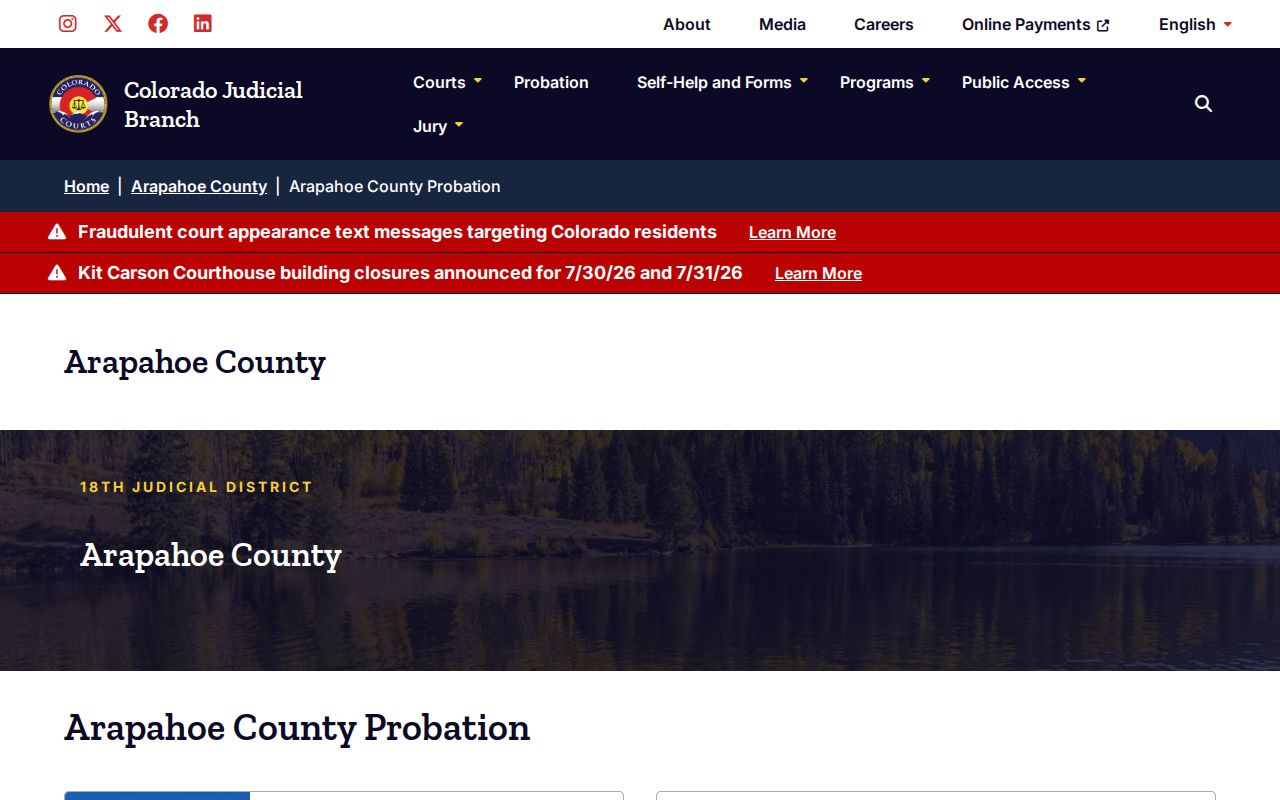
Use this local probation source for court-supervised release, and use CDOC sources for state parole after a prison sentence.
Arapahoe Reentry Placements
Arapahoe County has a named community-corrections landscape, so not every release path is a simple jail-to-home event. The county Judicial Services material describes alternative sentencing for the 18th Judicial District and Arapahoe County courts. It includes direct sentencing into a facility and placement after release from prison. That means a person may leave jail or prison but enter a structured community-corrections setting instead of ordinary unsupervised status.
The Arapahoe County Community Corrections Board lists Arapahoe Community Treatment Center, Centennial Community Transition Center, and Arapahoe County Residential Center as facilities. These are not current county-jail roster sources. Verification usually runs through the sentencing court, the board or referral process, CDOC if the person came from prison, and the supervising probation or parole office.
| Placement | Why it matters after release |
|---|---|
| Arapahoe Community Treatment Center | Community-corrections placement in Englewood, separate from jail roster verification. |
| Centennial Community Transition Center | Transition setting where court, board, and supervision records matter more than the jail lookup. |
| Arapahoe County Residential Center | Structured re-entry or direct-sentence setting that may follow prison or court placement. |
The source image below is from the Community Corrections Board page.
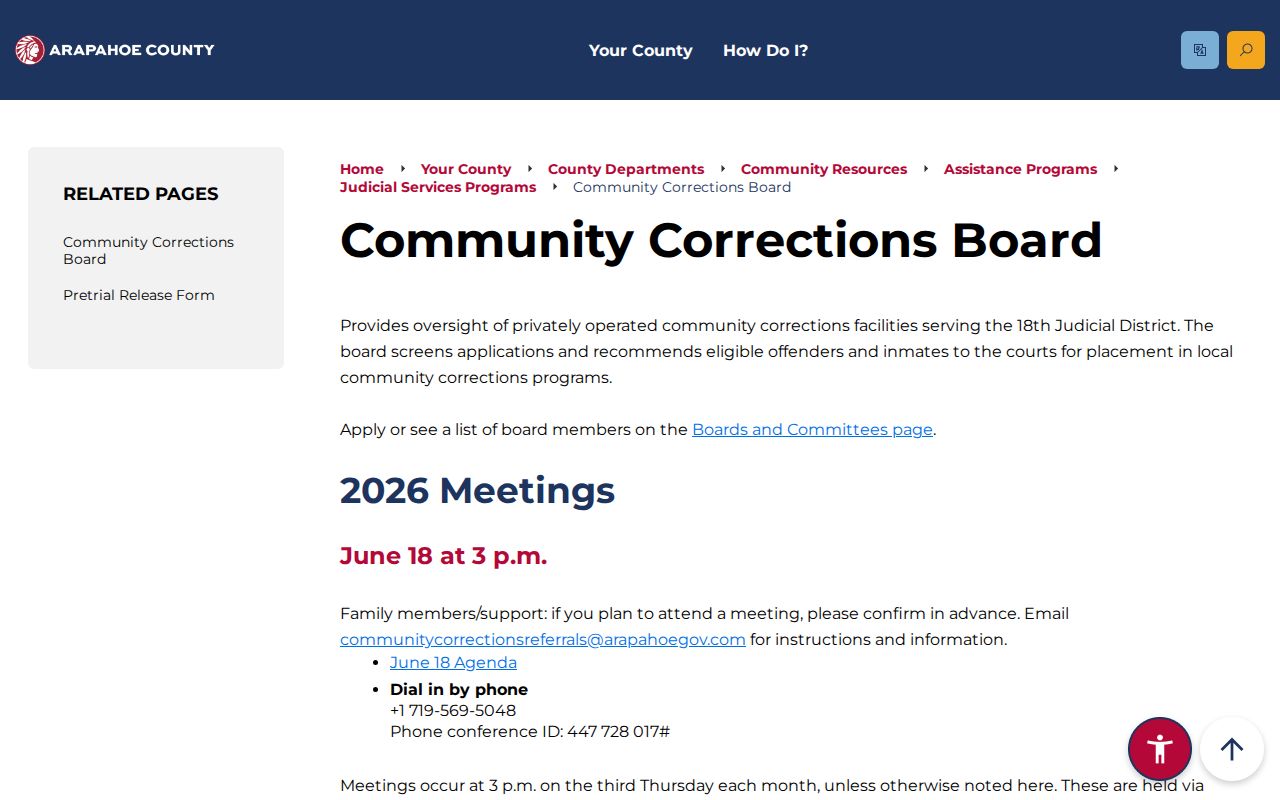
That county source is the key local clue when a release record points to re-entry placement rather than a simple discharge.
Arapahoe Probation Office Detail
Local probation verification belongs with the Judicial Branch, not the Sheriff's Office jail roster. The Judicial Branch lists several Arapahoe County probation locations, including the Justice Center Probation Office and the Lima main office in Centennial, plus Littleton locations. The Arapahoe court page also lists a general probation number for rescheduling appointments. Use the court case number when available, because probation staff may need the case context to route a status question.
Arapahoe County Probation
Justice Center Probation Office
7305 S. Potomac Street
Centennial, CO 80112
Phone: 720-213-7805
Lima Probation Main Office
6904 S. Lima Street
Centennial, CO 80112
General probation rescheduling line listed by the court: 720-213-7800.
Probation offices do not replace the court record. A court order, docket entry, probation minute order, or sentence document may be needed to prove the term, conditions, and whether the person is still under supervision.
Fixing Arapahoe Release Records
Correction of a release-record problem depends on the custodian. The Arapahoe County Sheriff's Records Unit manages criminal justice records that pertain to cases and bookings, but the unit says it does not maintain court dispositions. A jail booking or release-date issue belongs with the sheriff records path. A disposition issue belongs with the court. A CDOC release, parole, or discharge date belongs with CDOC and its records process.
This split is a common source of delay. A person may ask the sheriff for a sentence result that only the clerk can provide, or ask the court for a jail custody event that belongs with the sheriff. Use booking number, case number, DOC number, approximate dates, and the specific field in question. Purpose-neutral, narrow requests are easier to route and less likely to be rejected as too broad.
Note: A sealed court record may limit public access even when a custody event once appeared in an online or agency record.
Arapahoe Violations and Warrants
Supervision conditions vary by order, so public pages should not guess the terms for one person. At a high level, probation, parole, pretrial supervision, and community corrections can include reporting, treatment, travel limits, court appearances, sobriety monitoring, electronic monitoring, or placement rules. A violation may trigger a court hearing, a probation complaint, a parole revocation process, a warrant, or a return to custody.
The research did not find an Arapahoe County public parole absconder list tied to jail releases. For a violation concern, use the court docket, the probation office, CDOC offender status, the parole-board calendar for revocation settings, and the jail lookup if the person may have been booked again. Colorado VINE can help with custody-status changes for a monitored custody event, but it is not a general supervision file.
Arapahoe Supervision Discharge
Supervision ends when the supervising authority records discharge, termination, sentence completion, or another final outcome. For CDOC, the statutory discharge date is different from release to parole. It marks the point when the prison sentence and possible parole time have been completed. For probation, discharge or termination is usually shown in the court case or probation record. For community corrections, the placement outcome may also be reflected in court or CDOC records.
Colorado criminal justice records are subject to the Colorado Criminal Justice Records Act. Public access can be limited by sealed records, juvenile rules, victim or witness protections, active-case restrictions, or redaction. If the goal is to prove that supervision ended, request the specific discharge, termination, or disposition record from the correct custodian rather than relying on the absence of a name from a roster.