
Residential Center Transitions
The Facility Map identifies Arapahoe County Residential Center as a community-corrections center operated by GEO Reentry Services and listed by Arapahoe County as a Littleton community-corrections facility. Community corrections may be used as a direct sentence or as re-entry placement after prison. That distinction controls where proof of exit or completion is found.
A person who exits this center may return to the community under probation or parole, transfer to another program, return to jail or prison after a violation, or complete a court-ordered placement. The Arapahoe County jail search is not the right source unless there is a separate booking into the Arapahoe County Detention Facility.
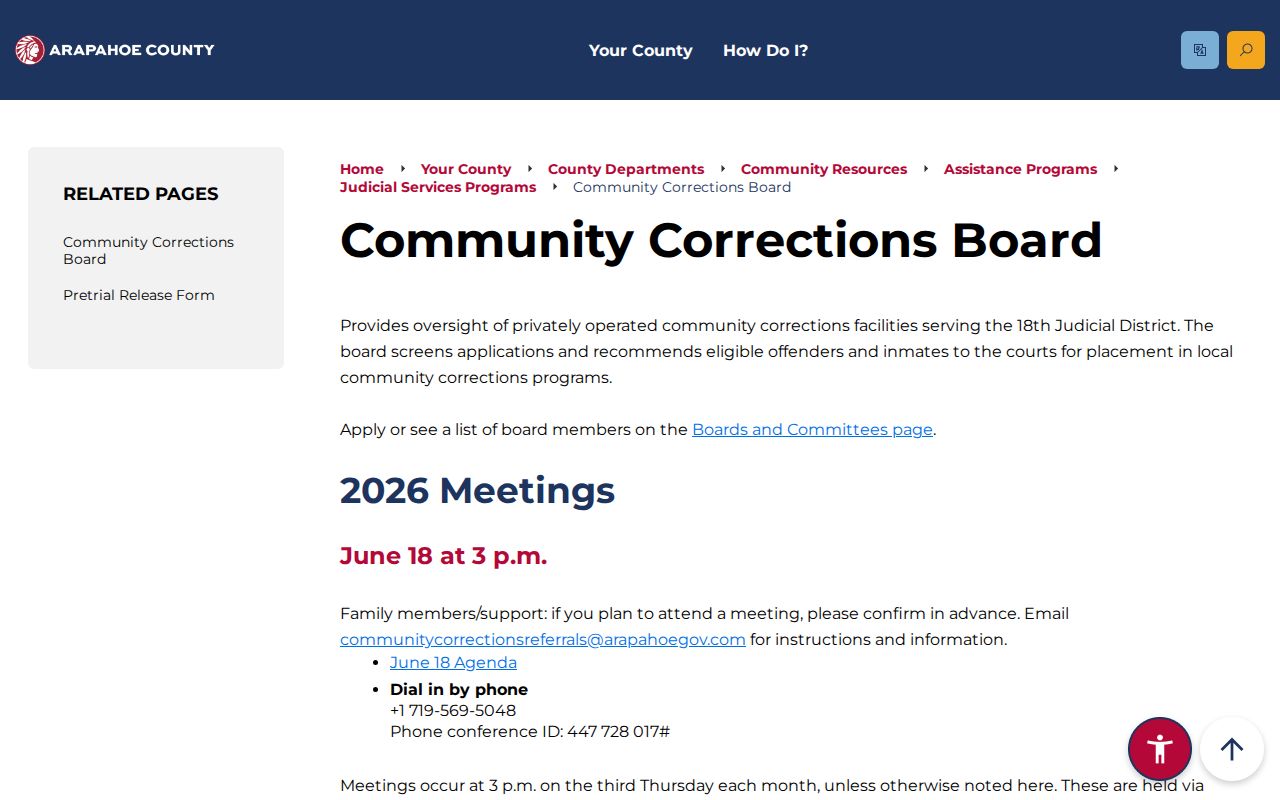
Source view from the manifest: Arapahoe County Community Corrections Board source context.
How to Confirm an ACRC Exit
Begin with the source of the placement. If the court ordered the placement, the Arapahoe County case record is the anchor. If the placement followed a Colorado prison sentence, the CDOC offender search may show prison release, parole, discharge, and sentence-status information. If probation or parole supervised the person, the local supervising office is the better verification route.
- Use the Colorado Judicial Branch docket and document request process for the Arapahoe court case.
- Review Arapahoe County community-corrections board information to identify the placement category.
- Search CDOC when the person came from state prison or appears under a DOC number.
- Use parole or probation records to confirm supervision after leaving the residential center.
- Use the Sheriff's Records Unit only if the person was later booked into the county jail.
Residential Center Records
The research block lists GEO Reentry Services as operator and identifies the facility as a Littleton community-corrections site, but it does not provide a captured street address or direct phone number for this page. This page therefore avoids a fabricated contact card and points users to the documented custodians: Arapahoe County Community Corrections Board, the sentencing court, CDOC, and the supervising parole or probation channel.
Direct Sentence or Re-Entry
The important release-record detail is whether the residential center placement came instead of jail time or after release from prison. A direct-sentence placement is best documented through court orders and probation or community-corrections records. A re-entry placement after prison also requires CDOC context because release to community corrections is not the same as full discharge from a state sentence.
That distinction also affects what a search result means. A person may be outside the Arapahoe County Detention Facility but still live under a court order, a community-corrections placement, parole, or probation. A person may also leave the residential center and then appear in the county jail lookup because of a new arrest, violation, warrant, or court transport. The facility page should therefore be read as a placement-status path, not as proof that all criminal justice involvement has ended.
ACRC Custodian Split
Arapahoe County Residential Center release questions often involve more than one record custodian. The Community Corrections Board can help identify the local facility group and placement context. The court can explain the sentence, direct placement, violation, modification, or discharge order. CDOC can explain prison release, parole date, statutory discharge, or state supervision if the person arrived as a re-entry placement. Probation or parole records can explain continuing supervision after the person leaves the residential center.
The Sheriff's Records Unit should not be used as the first source for ACRC placement records unless the person was also booked into the Arapahoe County Detention Facility. If that happened, the jail record may show booking, custody, release, bond, charge, or transfer details for the separate jail episode. It will not necessarily explain why the person was originally placed in community corrections or whether the residential-center placement was completed.
| Record issue | Likely custodian |
|---|---|
| Community-corrections placement | Arapahoe County Community Corrections Board and court records. |
| Sentence or direct placement | Colorado Judicial Branch Arapahoe court file. |
| Prison re-entry status | CDOC offender search and records. |
| Supervision after exit | Probation or parole source tied to the case. |
| New jail custody | Arapahoe County Sheriff's Office records. |
Verify Residential Center Status
A careful verification sequence prevents a common mistake: treating every community-corrections exit as a jail release. Start with the court because the court order often explains why the person was placed at the center. Then use CDOC if the placement followed prison, and supervision contacts if parole or probation continues. Use the jail lookup only to see whether a new or separate county booking exists.
Ask for precise records. A request for "everything" may be slower and less useful than a request for the sentence order, placement order, completion record, revocation order, custody transfer record, or CDOC release/discharge information. When a source says no record is available, confirm that the request went to the correct custodian before treating that answer as the final status.
After Residential Placement
After a person leaves Arapahoe County Residential Center, the next public record depends on the outcome. Completion may show in the court file or supervising-office record. A move to parole or probation may show through CDOC, Adult Parole, or Arapahoe County Probation. A return to custody may appear in the county jail lookup, a court docket, or CDOC depending on the receiving system. A transfer to another program may require the placement record rather than a jail record.
This is why the page avoids a single "released list" promise. The research identifies ACRC as a structured community-corrections site, and the official sources do not describe it as a public rolling release feed. The accurate search is a chain: identify the original placement, find the custodian that ordered it, then follow the documented outcome to supervision, completion, transfer, or new custody.
If a family member or case participant needs timing, ask the relevant office for the placement status or release/exit confirmation. If a written public record is needed, use the court or records process tied to the event. Do not rely on absence from the sheriff's current roster unless the question is limited to current county jail custody. For public-record wording, call it a placement or transition record unless the source itself uses the word release.