
Arapahoe Scheduled vs Actual Release
A projected release date is not the same as the actual release event. A projected, tentative, parole-eligibility, mandatory-release, or discharge date can move before release occurs. The actual release is the custody event recorded by the agency that held the person. For the Arapahoe County Detention Facility, the public current lookup shows booking, bond, charge, docket, and court information, but the research did not find a public county projected-release-date field.
Key point: CDOC release-date fields apply to state prison records. Arapahoe County jail release timing is usually confirmed through the court order, sheriff custody record, bond status, or transfer record.
A pretrial detainee has no fixed release date in the same way a sentenced prisoner might. Bond posting, a judge's order, dismissal, sentence credit, detainer, transfer, or administrative processing can change what happens next. For a person serving a short jail sentence, the mittimus, court order, and sheriff custody record are better sources than any public calculator.
Find an Arapahoe Projected Date
Start with the system that controls the custody. A person in county jail, a person in Colorado state prison, and a person held under federal or immigration authority use different date sources. The Arapahoe County released inmates search path can identify the system first, then the projected release date question can be routed to the custodian that actually computes time.
- Search the Arapahoe County current custody lookup to see whether the person remains in the county jail and to capture booking, bond, charge, docket, and court information.
- For a county jail sentence or pending case, use the court docket, sentence document, mittimus, or Sheriff's Records Unit for release-date confirmation.
- For a Colorado prison sentence, search the CDOC offender search by DOC number when available, or by name and identifiers.
- Review CDOC date labels carefully, including parole eligibility date, mandatory release date, release date, and statutory discharge date where shown.
- Use VINELink release notifications for alerts near a custody change, then verify the official date with the custodian.
The source image below is from the CDOC offender-search tips, which explains search identifiers used for Colorado prison records.
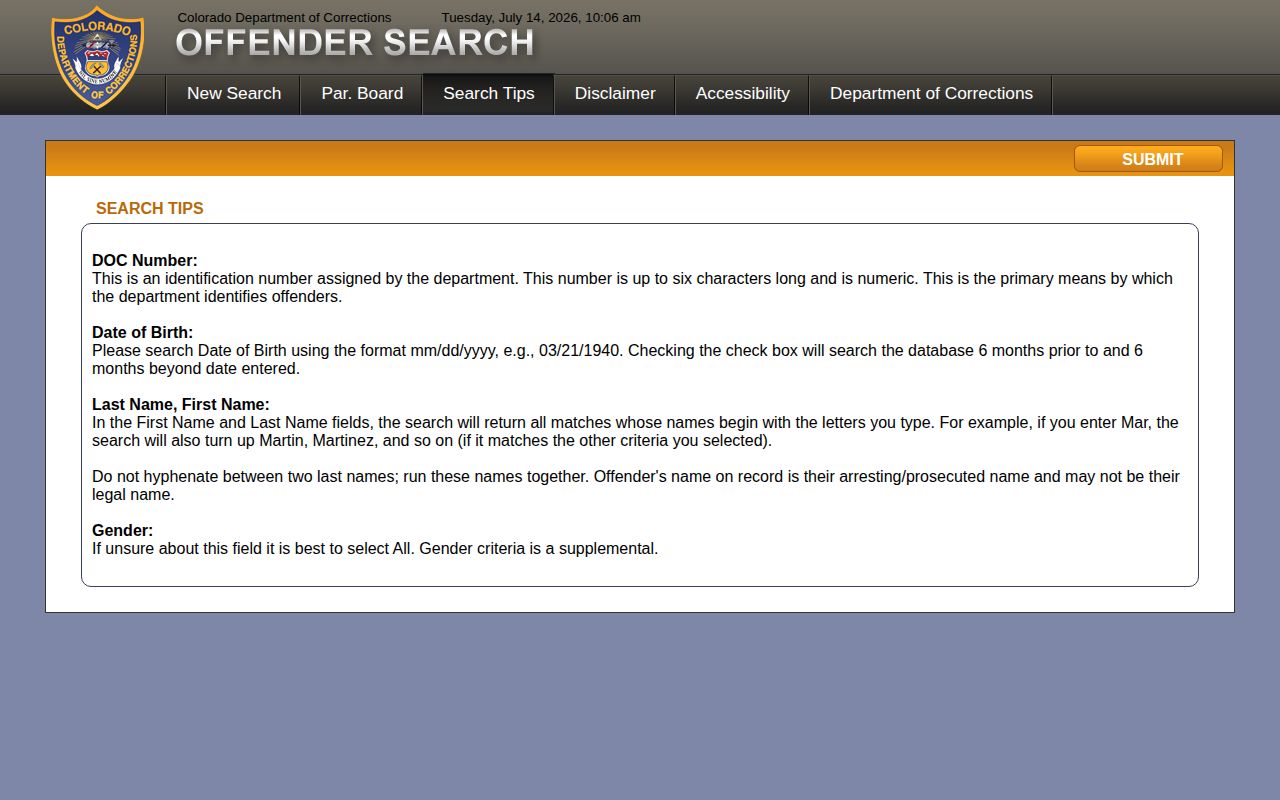
Those CDOC search rules matter when an Arapahoe County case has moved from local jail custody to state prison custody.
CDOC Release Date Labels
Colorado prison records may use several date concepts. They are not interchangeable. A parole eligibility date can mark when parole may be considered. A mandatory release date can be a statutory time point affected by credits and rules. A release date records the custody change. A statutory discharge date marks completion of the prison sentence and all possible parole time. The Colorado State Board of Parole report explains SDD as the date when both the prison sentence and all possible parole time have been completed.
| Date label | How to read it |
|---|---|
| Parole Eligibility Date | The point at which parole consideration may be available under statute and credits. |
| Mandatory Release Date | A major time-computation date that may appear in parole decisions and CDOC records. |
| Release Date | The date the person left a custody status, which may still lead to parole or supervision. |
| Statutory Discharge Date | The date the sentence and all possible parole time are complete. |
A release to parole should not be treated as no supervision. It means the person left prison custody and entered a post-release status. For the supervision side, use Arapahoe County parole and probation sources.
The CDOC parole-board calendar can help explain why a projected date is not final. The calendar at CDOC parole-board hearings lists hearing months and warns that schedules are subject to change. Application, rescission, and revocation hearings are different events. A hearing setting can show that parole is being considered or reviewed, but it does not prove release occurred. Pair the calendar with the offender record and the final custody status.
Colorado Earned-Time Rules
Colorado release-date computation is statutory and individual. C.R.S. 17-22.5-403 controls parole eligibility for many Colorado sentences, with different rules for offense type, offense date, violent or enumerated offenses, and later statutory changes. The research supports careful wording: certain offenses have 50 percent, 75 percent, or 85 percent structures depending on the statute and effective dates. It does not support applying one percentage to every sentence.
C.R.S. 17-22.5-405 governs earned time, earned release time, and achievement earned time. Credits can be tied to conduct, program compliance, class 4, 5, and 6 felony or drug felony provisions near mandatory release, program milestones, or exceptional conduct, subject to caps and limits. These credits can move an official projected date, but they are not a public promise outside CDOC's time calculation.
The source image below comes from the Colorado earned-time statute page used for Arapahoe County projected release-date research.
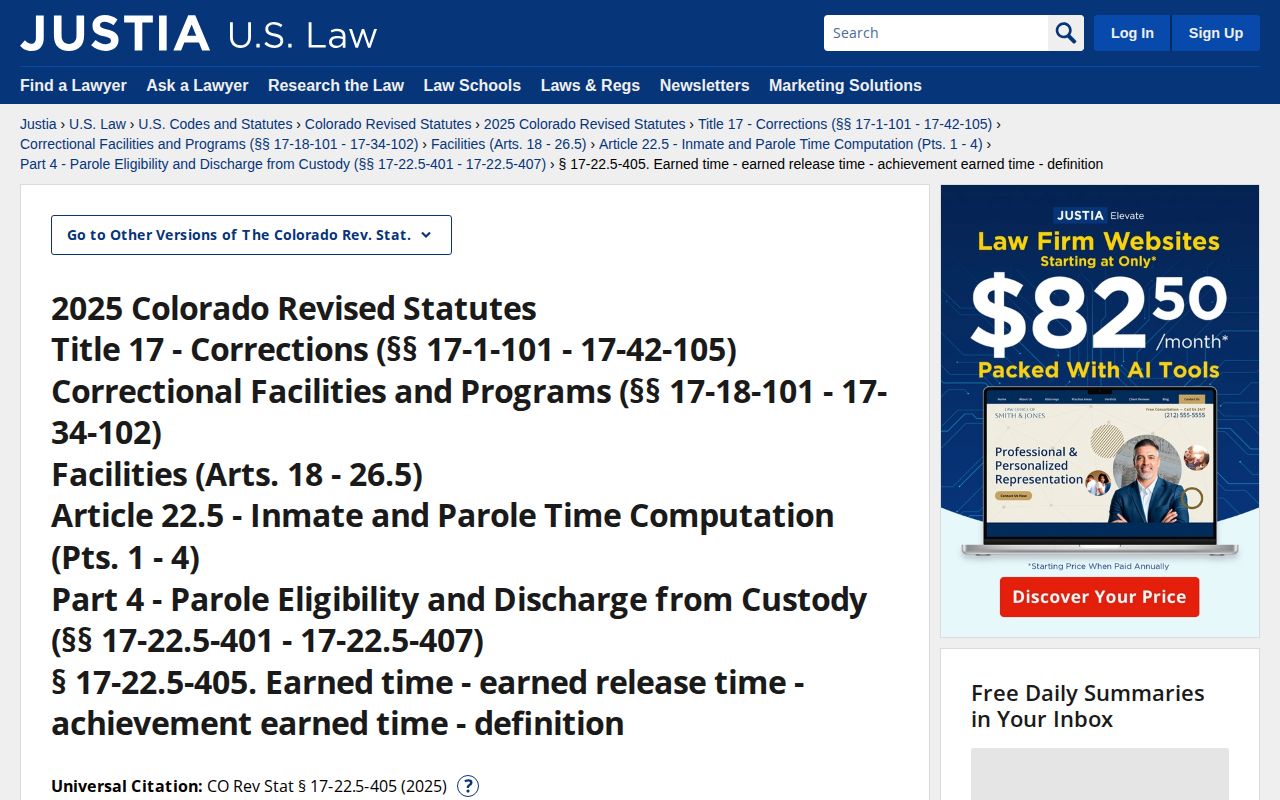
Use the statute to understand why a date can change, but use CDOC or the court for the official date in a specific case.
Why Arapahoe Release Dates Change
A release date can change because the date is based on more than the sentence length. Presentence confinement credit, consecutive or concurrent sentence treatment, good-time loss, detainers, parole decisions, new warrants, and court modifications can all matter. A person with the same sentence length as another person can have a different projected date because the custody history and legal conditions differ.
| Factor | Effect on date |
|---|---|
| Presentence confinement credit | May reduce time remaining if credited by the court or custodian. |
| Earned time or loss of credits | Can move the projected date earlier or later under Colorado law. |
| Detainer or hold | May mean release from one agency is a transfer to another agency. |
| Parole decision | Can result in release, deferment, rescission, or revocation-related action. |
| New court order | Can alter bond, sentence, custody, or supervision status. |
Note: A disappeared jail roster entry can mean release, transfer, spelling mismatch, or booking under another source, so confirm before relying on it.
Arapahoe Jail Date Quirks
The Arapahoe County current lookup does not state a release-date calculator, release cadence, or post-release retention window in the captured text. It shows current custody and case details such as name, ID, booking, bond, charges, docket or disposition, and court date/location. That makes it useful for current status and case routing, but not for computing a future jail release date.
For a county sentence, ask for the court order or sheriff custody record. For a bond release, the bond fields and court case can explain the release path. For a transfer, the release record may point to CDOC, ICE, BOP, USMS, or another receiving agency. For community corrections, the sentencing court and Arapahoe County Community Corrections Board context may explain why the person left jail but remained in a structured placement.
Arapahoe County also has local custody layers that make release wording important. Aurora municipal holding, community-corrections facilities, the county jail, and the Aurora ICE processing center are not one system. A record may say released from Arapahoe County custody while another agency still has legal custody. If the release reason mentions transfer, detainer, mittimus, ICE, federal hold, or DOC, follow the receiving system rather than assuming the person returned to the community.
Confirm an Arapahoe Release Date
Use a written source when precision matters. For jail custody, request the booking or custody record through the Arapahoe County Sheriff's Records Unit or online records portal. For case outcome, use the Colorado Judicial Branch docket, document request form, or Arapahoe court record email. For prison release and discharge, use CDOC search and records channels. For a pending release alert, register through VINE before the event if possible.
Ask for the specific date type needed. A release date, a parole eligibility date, a mandatory release date, and a statutory discharge date answer different questions. For a county jail case, ask whether the person was released, transferred, bonded out, sentenced to time served, or moved to another custody source. For a CDOC case, ask whether the date is projected, actual, parole-related, or discharge-related. Precise wording reduces the chance of getting a correct record that answers the wrong question.
Date Confirmation Channels
Arapahoe County Detention Facility
7375 S. Potomac St., Centennial, CO 80112
Detentions Main and Automated Information System: 720-874-3500
Sheriff Records Unit
Records phone: 720-874-3875
Online portal: Arapahoe records request
Colorado Judicial Branch
Arapahoe case documents: record/document request form