
Centennial Transition Release Path
The Facility Map identifies Centennial Community Transition Center as a community-corrections center listed by Arapahoe County as an Englewood facility. The research did not capture a separate address or public phone for this specific center, so those details are not invented here. The record question is still clear: CCTC is a placement and transition setting, not a live county jail roster or a public recent-release feed.
A resident's exit can mean completion of a placement, a move to another program, a return to custody, a court modification, parole action, probation action, or a CDOC-related re-entry change. If the person came from Colorado prison, CDOC may show prison release, parole, discharge, or sentence status. If the person was directly sentenced by an Arapahoe court, the court order is the durable record. If the person was booked into the Arapahoe County Detention Facility after leaving CCTC, then sheriff jail records become relevant for that separate custody event.
The Arapahoe County Community Corrections Board page supplies the local community-corrections context for this facility group.
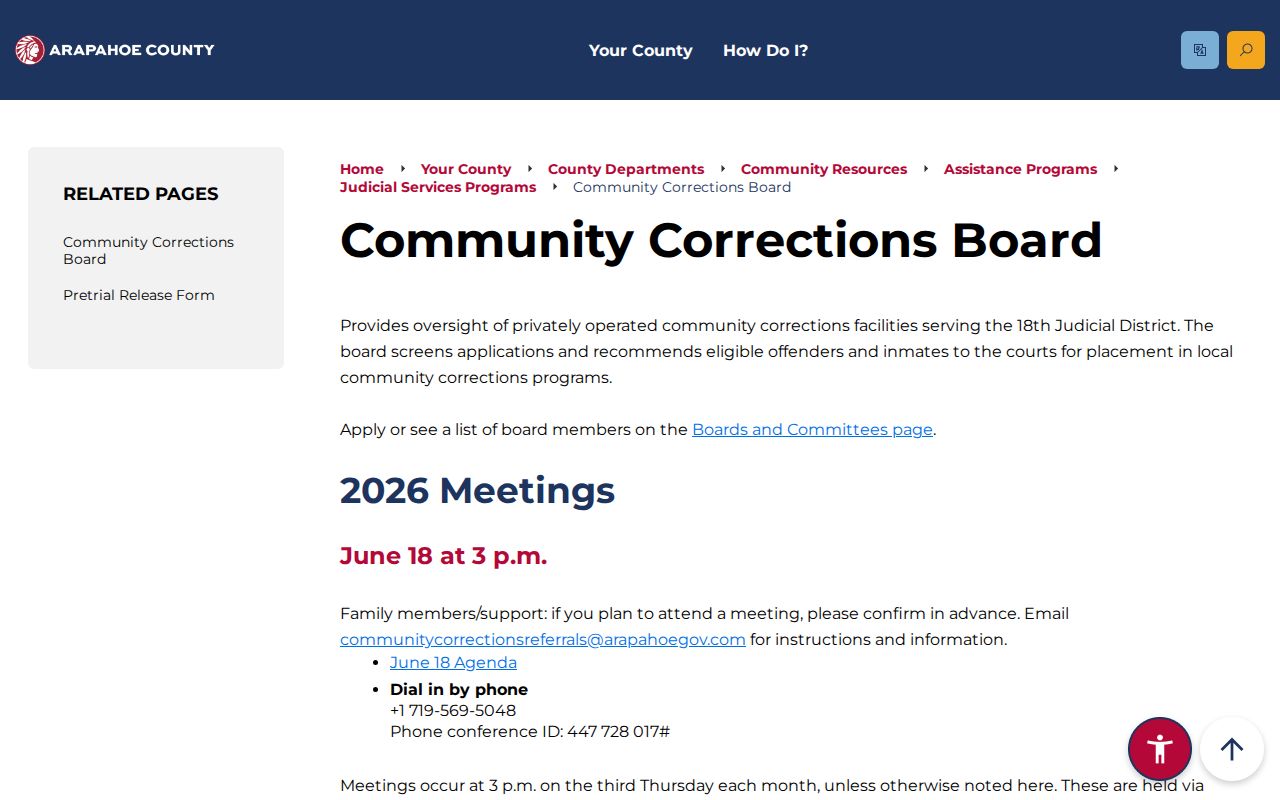
That county source helps identify the facility type, while the case-specific release or transition record must come from the court, CDOC, or supervision channel.
Confirm a CCTC Exit
The confirmation route starts with the placement authority. Search the Colorado Judicial Branch docket for the Arapahoe case, then request the order or case document if the docket does not show the placement detail. If the person was placed after prison, search CDOC by DOC number or name and compare identifiers before relying on the record. If supervision continues, use the parole or probation office tied to the case.
- Identify whether the placement was direct sentence, re-entry after prison, parole condition, probation condition, or another court order.
- Use court records for sentence, modification, violation, revocation, completion, or discharge language.
- Use CDOC for prison release, parole, discharge, and statutory date context when the person came from prison.
- Use Arapahoe County Probation when the court record points to probation supervision.
- Use Adult Parole or CDOC parole records when the person left prison to parole.
- Use the sheriff's records portal only if a separate jail booking or transfer occurred.
CCTC Records and Contact
No address or phone was captured for Centennial Community Transition Center in the research block. The page therefore routes readers to the offices documented in the source material: Arapahoe County Community Corrections Board for facility context, the Colorado Judicial Branch for court documents, CDOC for prison re-entry records, and probation or parole for ongoing supervision. This keeps the page accurate without adding unsupported contact data.
| Need | Use this source |
|---|---|
| Placement order or completion | Arapahoe County court record request. |
| Re-entry after prison | CDOC offender search and records. |
| Probation status | Arapahoe County Probation. |
| Parole status | CDOC parole and parole-board sources. |
| Jail booking after exit | Arapahoe County Sheriff's Records Unit. |
Note: A person outside the county jail roster is not automatically released from every court or supervision obligation.
Arapahoe Community Corrections Role
Arapahoe County Judicial Services administers alternative sentencing programs for the local courts and the 18th Judicial District. Its materials describe community corrections as a direct placement or a placement upon release from prison. CCTC fits that local context. The center should not be described as a county jail, state prison, or ICE facility. It is a community-corrections transition site, so the release search is really a placement-status search.
For written proof, ask for the record that fits the legal event. A docket may show a hearing. A court document may show sentence or completion. CDOC may show release to parole or discharge. Probation may show court supervision. Parole may show prison-release supervision. Matching the request to the custodian is the safest way to avoid a wrong or incomplete answer.
CCTC Status Questions
Centennial Community Transition Center status questions should be sorted by the event being checked. A person may be entering the center from prison, moving from the center to supervision, returning to custody after a violation, or completing a court-ordered placement. Each event creates a different record trail. The Facility Map notes that a resident is not verified through the county jail current-inmate search unless separately booked into jail.
| Status question | Primary source |
|---|---|
| Was this a court-ordered placement? | Arapahoe County court documents. |
| Did prison release lead to CCTC? | CDOC offender records and parole context. |
| Did the person complete the placement? | Court record, community-corrections record, or supervising office. |
| Did the person return to jail? | Arapahoe County sheriff lookup and records portal. |
| Is supervision still active? | Probation or parole source tied to the case. |
This table is not a substitute for official confirmation. It is a way to choose the right custodian before sending a request.
CCTC Fallback Search
If the first source does not find the person, move by custody path. A no-match in CDOC suggests the placement may not have followed prison. A no-match in the county jail lookup suggests the person may not have been separately booked into the Arapahoe County Detention Facility. A thin docket result may mean a document request is needed because online docket text rarely contains the full placement history.
Use exact details when available: name, case number, DOC number, approximate placement date, and the known court or supervising agency. Avoid assuming that Centennial Community Transition Center has the same release records as the county jail. It is part of the county's community-corrections network, and the durable proof is usually the court, CDOC, or supervision record that created or ended the placement.
CCTC Lookup Mistakes
The most common mistake is using the Arapahoe County jail lookup as if it were a community-corrections roster. The jail lookup is useful for people booked into the county detention facility. It does not prove whether a CCTC placement is active, completed, modified, or revoked. The second mistake is treating a prison release date as full discharge. CDOC may show release to parole, while parole supervision can continue after the person enters or leaves a community-corrections setting.
Another common mistake is sending a broad request to one office and assuming a no-record response covers every system. For CCTC, the court, CDOC, probation, parole, and community-corrections channels answer different parts of the same history. Keep each request narrow and tied to the record that office is likely to hold.